
A Quiet Artist in the Busy Streets
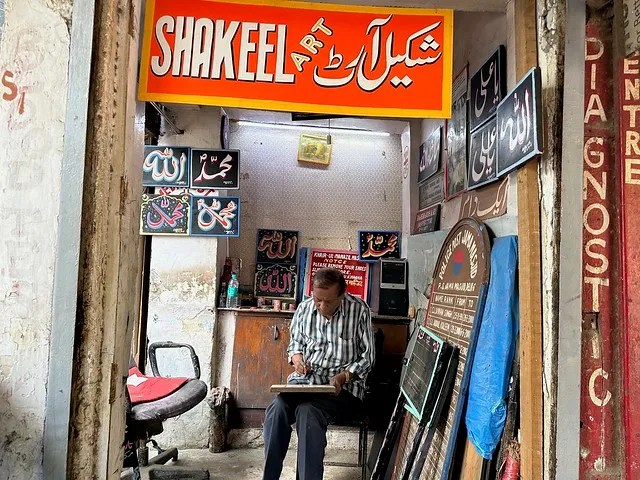
Old Delhi is known for its crowded markets, narrow lanes, and colourful shop boards. Every street is filled with signboards hanging above shops, some bright, some old, and some fading with time. Today, most of these boards are printed by machines, but if you look closely, you may still find a few where the letters are painted carefully by hand.
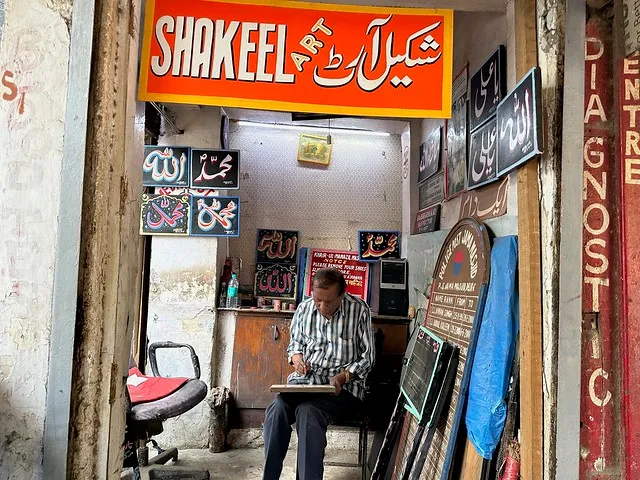
Behind many such boards is a man known as Shakeel Artist.
His real name is Shakeel Akhtar, and for more than forty years, he has been painting signboards in Old Delhi. In an age where computers can design and print boards within minutes, Shakeel still prefers the slow and careful method of using paint and brushes.
A Craft Learned at Home
Shakeel did not learn this craft from any modern design institute. The skill runs in his family. His father was also a signboard painter, and his grandfather was known for beautiful calligraphy.
As a child, Shakeel spent a lot of time watching letters appear on wooden boards. At first, he only observed his father working. Slowly, he began helping with small tasks like mixing colours or holding boards. With practice, he started outlining letters and eventually painting complete signboards himself.
Over the years, the brush became a natural extension of his hand.
Teaching the Art to Others
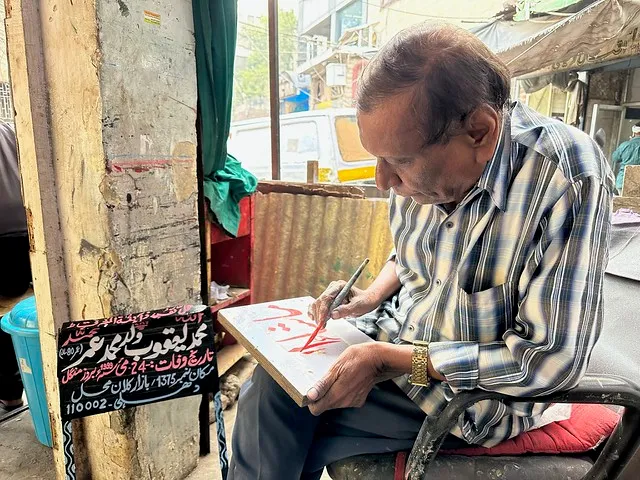
Shakeel did not keep this knowledge only to himself. Over time, he started teaching others who were interested in learning signboard painting.
In total, around 120 people learned this craft from him. What is interesting is that most of his students were women. Nearly 70 to 80 women learned sign painting under his guidance, while only 20 to 25 were men.
For many of these women, learning the skill gave them a chance to develop creativity and even earn independently. Shakeel patiently taught them everything from how to hold a brush properly to how to balance letters and colours on a board.
Through his teaching, the tradition of hand-painted lettering continued to spread.
The Golden Time of Hand-Painted Signboards
There was a time when hand-painted signboards were very common in Delhi. Shops, advertisements, and cinema banners were all created using paint and brushes. Skilled painters were responsible for designing the boards that gave identity to shops and businesses across the city.
Shakeel was also involved in painting large film posters. He worked on banners for movies like Arzoo, Safar, and Mere Lal. These banners were very large, sometimes 12 by 24 feet, and required great skill and precision. Artists would stand on scaffolding and carefully paint images and titles using small reference photographs.
A Craft That Once Filled the Streets
Before digital printing became popular, signboard painting was a common profession in cities like Delhi. Every shop, whether a small grocery store, clinic, tailor shop, or restaurant, needed a painter to create its board.
Artists like Shakeel would first sketch the letters lightly using chalk or pencil. Then they would carefully paint the outlines and fill them with enamel colours. Each board required patience, steady hands, and attention to detail.
Because everything was done manually, every signboard looked slightly different. This uniqueness gave character to the streets of Old Delhi.

When Technology Changed Everything
With the arrival of computers and digital printing machines, the situation slowly began to change. Printed flex boards became cheaper and faster to produce. Shop owners preferred designs that could be made quickly.
As a result, many traditional signboard painters had to leave this profession and search for other work. The workshops that once echoed with the sound of brushes and paint gradually disappeared.
Only a few artists like Shakeel continued working in the traditional way.
Why Hand-Painted Work Still Matters
Despite the challenges, Shakeel still believes that handmade art has a special value. According to him, digital designs may look perfect, but they lack the warmth and personality of hand-painted work.
When a board is painted by hand, every stroke carries the effort of the artist. Small imperfections make the work unique rather than identical to printed boards.
For Shakeel, painting is not only a profession but also a form of expression.
Keeping a Tradition Alive
Even today, Shakeel continues to paint shop boards, nameplates, and Urdu lettering. If you walk through the lanes of Old Delhi and observe carefully, you might notice a small signature in the corner of some boards: “Shakeel Art.”
That small signature represents years of dedication, patience, and tradition.
In a city that is constantly changing with new technology and modern designs, Shakeel Akhtar quietly continues his work, proving that some forms of art survive simply because someone believes in them enough to keep going.


Leave a Reply