
How to Turn Your Tax Savings into Your Next Great Adventure
If you’re like me, your mind is usually halfway up a mountain or scouting for the next perfect heritage shot. But as we move further into 2026, there’s a bit of “jersey-side” paperwork we need to tackle to keep our “journeys” sustainable.
The Leave Travel Allowance (LTA) is one of the most effective ways for salaried professionals in India to explore the country while reducing their tax burden. However, 2026 is a pivotal year for your travel fund. Here is the verified breakdown of how to maximize your benefits under current government guidelines.
Whether you’re a private sector pro or a dedicated government employee, the 2026 LTA/LTC reset is your ticket to a smarter vacation. For those in government service, this benefit is even more robust. Under the CCS (LTC) Rules, government employees don’t just get tax exemptions; they often receive full reimbursement for travel to their ‘Home Town’ or ‘Anywhere in India’ within defined blocks. Plus, with the current LTC air travel relaxation (extended through September 2026), many employees can even fly to breathtaking spots like the North East, J&K, or the Andaman & Nicobar Islands, regardless of their usual grade pay entitlement. It’s the state’s way of saying, ‘Go explore—we’ve got the ticket covered!’”
The Block Year Mystery: Where Do We Stand?
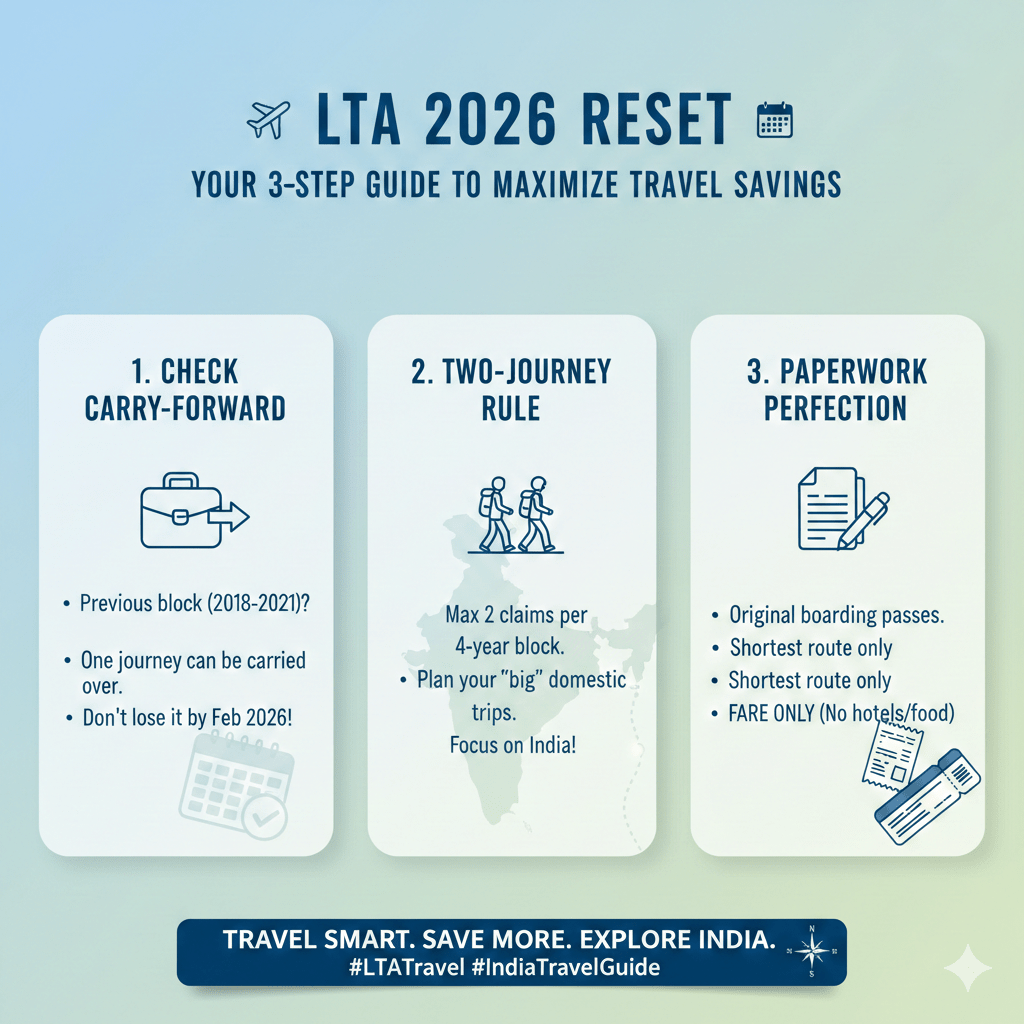
LTA isn’t based on the financial year; it follows a four-year calendar block system set by the Government of India.
- Current Block: 1 January 2022 to 31 December 2025.
- The 2026 Transition: Since we are now in 2026, we have technically entered the first year of a potential new block (2026–2029).
- The “Carry-Over” Rule: If you didn’t claim your two allowed journeys during the 2022–2025 block, you can carry forward one journey. Crucial Tip: You must utilize this carried-forward journey within the first calendar year of the new block (i.e., by December 31, 2026), or you lose it forever.
What Exactly Can You Claim?
Under Section 10(5), the exemption is strictly limited to actual travel costs. This is where many travelers get tripped up:
- Covered: Airfare (Economy Class), Rail (AC First Class), or recognized public transport (Bus/Deluxe) by the shortest route.
- New for 2026: If you travel to a remote spot not connected by rail or public transport, the Draft Income-tax Rules 2026 propose a cap of ₹30 per kilometre for the shortest route.
- Not Covered: Your luxury hotel stay, that celebratory dinner after a long trek, or local sightseeing cabs. Only the “point-to-point” fare between your origin and destination qualifies.
The “Jersey” Rules: Compliance & Regimes
- The Old vs. New Tax Regime: This is the big one. LTA exemptions are only available under the Old Tax Regime. If you have opted for the New Tax Regime (Section 115BAC), this allowance is fully taxable.
- Family Definition: You can claim for yourself and your family (spouse, two children, and dependent parents/siblings). Note the two-child restriction for those born after October 1, 1998 (unless the second birth resulted in multiple children like twins!).
- Proof is Mandatory: While the Supreme Court previously ruled that employers aren’t always required to collect proofs, the Draft Rules 2026 signal tighter compliance. Keep your boarding passes and original tickets safe—digital copies are great, but physical evidence is your best defense in an audit.
Government Sector: Mastering Your LTC (Leave Travel Concession)
For government employees, the rules are governed by the CCS (LTC) Rules. It’s not just an allowance; it’s a reimbursement of actual costs.
- Home Town vs. Anywhere in India: You get one “Home Town” LTC and one “Anywhere in India” LTC in a two-year sub-block (e.g., 2026-27).
- Special Relaxations (Extended to 2026): The government has extended the relaxation for air travel to the North East Region (NER), Jammu & Kashmir, Ladakh, and Andaman & Nicobar Islands until September 25, 2026. Even if you aren’t usually entitled to fly, you can convert your Home Town LTC to visit these regions by air in Economy class.
- Leave Encashment: Government employees can encash up to 10 days of Earned Leave (EL) while availing LTC, provided they have a balance of at least 30 days of EL after the encashment.
Quick Comparison: LTA vs. LTC at a Glance
| Feature | Private Sector (LTA) | Government Sector (LTC) |
| Authority | Section 10(5) Income Tax Act | CCS (LTC) Rules, 1988 |
| Frequency | 2 journeys in a 4-year block | Home Town (2 yrs) / All India (4 yrs) |
| Air Travel | Economy Class (National Carrier) | Entitled class as per Level/Grade Pay |
| Booking | Any source (must keep tickets) | Mandatory booking via Balmer Lawrie/Ashok/IRCTC |
| Encashment | Not available on travel | Up to 10 days EL encashment allowed |
Final Takeaway
Don’t let your hard-earned money sit in the taxman’s pocket when it could be funding your next trek to the Jaunsari hills or a heritage walk through Old Delhi. Check with your HR today to see if you have a carry-over journey waiting for you!
Note: Tax laws can be as winding as a mountain trail. If you have a complex situation, always consult with a tax professional.


Leave a Reply